How does a neural network work?
A neural network is an AI model made of layers of simple units connected by adjustable numbers called weights. It works by passing an input, such as the pixels of a photo, through the layers until it becomes a guess. During training, it compares each guess with the right answer and nudges millions of weights until its guesses become reliable.
▶ Try it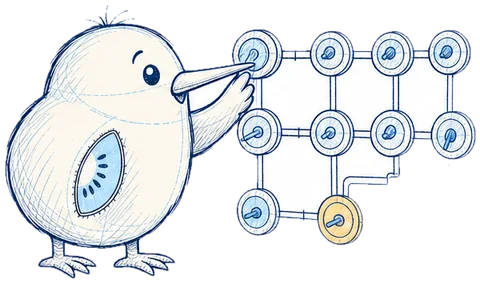
Why it matters
Behind face unlock, translation and chatbots sits the same idea: layers of simple units whose connection strengths are tuned by feedback, not programmed by hand.
In 6 minutes you'll be able to
- A neural network is layers of simple units joined by adjustable weights.
- Training means guess, compare with the right answer, nudge the weights, repeat.
- Its knowledge is spread across many numbers, so its reasons are hard to explain.
What you'll practise
Parts of a network
Tap each card to reveal how it works.
- ⚪ Neuron (unit)
- A tiny calculator. It adds up the numbers coming in, each multiplied by a weight, and passes on a result. Much simpler than a brain cell.
- 🎛️ Weight
- A dial on each connection that sets how much one unit influences the next. A big network has millions or billions of them.
- 🥞 Layers
- Units are stacked in layers. Early layers pick up simple things like edges; later layers combine them into shapes, then into “this is a 7”.
- 📣 Feedback
- After each guess, the network measures how wrong it was and works out which dials to nudge, and in which direction, to be a little less wrong.
One training round
The network is learning to read handwritten numbers. Put one round of training in order.
- A labelled example comes in: a photo of a handwritten 7
- The pixels flow through the layers
- The network guesses: “probably a 1”
- The guess is compared with the label “7”
- Every weight is nudged a little to reduce the error
- Repeat with the next example, many thousands of times
Check your model
Who sets the millions of weights in a trained network?
- The training process, by learning from feedback (Answer)
- Programmers type in each value by hand
Is an artificial neural network a copy of the human brain?
- No, it's loosely inspired by it and far simpler (Answer)
- Yes, it works just like real neurons
Noor asks: “Why did the network say this cat is a dog?” Why is that hard to answer?
- The reason is spread across millions of weights (Answer)
- The network is hiding its reasons on purpose
Remember
A neural network learns by guessing, getting feedback and nudging its weights, over and over.
A neural network learns by guessing, being corrected and turning its dials a little, millions of times.
Key facts
- Psychologist Frank Rosenblatt described the perceptron, an early learning artificial neuron, in 1958. · Source: F. Rosenblatt, The Perceptron, Psychological Review, 1958
- A 1986 paper in Nature showed how multi-layer networks can learn by passing the error backwards and adjusting weights, a method called backpropagation that is still central today. · Source: Rumelhart, Hinton & Williams, Learning representations by back-propagating errors, Nature, 1986
- The 2024 Nobel Prize in Physics went to John Hopfield and Geoffrey Hinton for foundational discoveries and inventions that enable machine learning with artificial neural networks. · Source: The Royal Swedish Academy of Sciences, Nobel Prize in Physics 2024
- The adult human brain contains about 86 billion neurons, each a living cell far more complex than a unit in an artificial network. · Source: Azevedo et al., Journal of Comparative Neurology, 2009
Updated:
Questions people ask
How does a neural network learn?
It makes a guess, measures how far the guess is from the right answer and adjusts its weights slightly to reduce that error. Repeating this over many examples gradually makes its guesses accurate.
What is deep learning?
Deep learning is machine learning with neural networks that have many layers. The extra layers let the network build up complex patterns from simple ones.
Are neural networks the same as the human brain?
No. They are loosely inspired by brain cells, but each artificial unit is a simple calculation, and networks learn in a very different way from people.
What are neural networks used for?
Recognising faces and speech, translating languages, recommending videos, spotting patterns in medical scans and powering chatbots and image generators.
Related terms