How does AI generate images?
AI generates images mostly with diffusion models. They learn by removing noise that was added to millions of captioned images. To make a new picture, the model starts from pure random noise and removes a little at a time over many steps, steered by your prompt, until an image appears. It creates new pixels rather than pasting photos together.
▶ Try it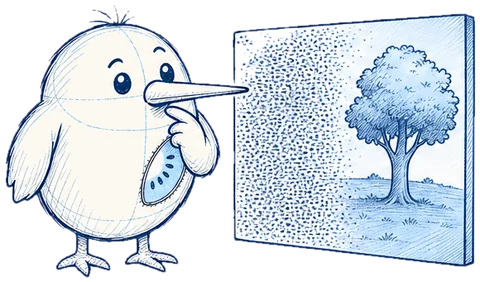
Why it matters
An image generator doesn't search for a photo or glue pieces together. It starts with static and keeps removing noise in the direction your words point to.
In 6 minutes you'll be able to
- Diffusion models start from random noise and remove it step by step.
- Your prompt steers every step; a new noise pattern gives a new picture.
- A realistic image isn't proof. Check the source before you share.
What you'll practise
The key ideas
Tap each card.
- 🖼️ What does it learn from?
- Huge collections of images paired with text descriptions. That's how it links the word “fox” to fox-like shapes and colours.
- 🌫️ What is the training game?
- Take a picture, add random noise, and ask the model to predict the noise so it can be removed. Practised at every noise level, millions of times.
- 🧭 What does the prompt do?
- Your words are turned into numbers that steer each clean-up step, so the noise is removed in the direction of “fox”, “book” and “lamp”.
- 🎲 Why is each picture different?
- Every image starts from a different random noise pattern, so the same prompt gives a new picture each time.
From prompt to picture
Put the steps of making one image in order.
- You type a prompt
- The prompt is turned into numbers the model can use
- The model starts from a canvas of pure random noise
- It predicts some of the noise and removes it, guided by the prompt
- It repeats this many times, each step a little clearer
- A finished image appears
Explain it
Your generated portrait has six fingers on one hand. Why does that happen?
- It learned what hands look like, not how many fingers they have (Answer)
- It copied a photo of a person with six fingers
Is an AI-generated picture a collage of photos from the internet?
- No, it builds new pixels from learned patterns (Answer)
- Yes, it cuts and pastes pieces of real photos
A very realistic photo of a famous building on fire is going around. What does this lesson tell you?
- Realistic doesn't prove it happened; check trusted news first (Answer)
- It's too detailed to be AI
Remember
Image generators sculpt pictures out of noise, guided by your words. Realistic doesn't mean real.
Image generators sculpt pictures out of noise, guided by words. Realistic doesn't mean real.
Key facts
- The idea behind diffusion models, learning to reverse a process that gradually adds noise to data, was introduced in a 2015 research paper. · Source: Sohl-Dickstein et al., Deep Unsupervised Learning using Nonequilibrium Thermodynamics, ICML 2015
- A 2020 paper that made diffusion models practical for high-quality images used 1,000 noise steps between a clean image and pure noise. · Source: Ho, Jain & Abbeel, Denoising Diffusion Probabilistic Models, NeurIPS 2020
- Under the EU AI Act, providers of AI systems that generate images, audio, video or text must mark the output in a machine-readable way so it can be detected as AI-generated, and people who publish deepfakes must disclose them. · Source: EU Artificial Intelligence Act, Regulation (EU) 2024/1689, Article 50
- An open technical standard from the Coalition for Content Provenance and Authenticity (C2PA) lets cameras and apps attach “content credentials” that record how an image was made or edited.
Updated:
Questions people ask
What is a diffusion model?
A diffusion model is a type of generative AI that learns to remove noise from images. To create a picture, it starts from random noise and cleans it up step by step, guided by a text prompt.
Does AI copy existing images?
Generators create new pixels from patterns they learned, rather than pasting photos together. But they can imitate styles and occasionally reproduce images they saw many times, which is why training data and copyright are debated.
Why does AI get hands and text wrong?
The model learns how things usually look, not rules like “five fingers” or how to spell. Complicated, highly variable shapes such as hands and lettering are harder to get right from patterns alone.
How can you tell if an image is AI-generated?
Look for content labels or credentials, check where the image first appeared and do a reverse image search. Visual glitches can help, but no single clue is reliable.
Related terms