What are the red flags in a relationship?
Red flags in a relationship include demanding your passwords, wanting to see your location all the time, secretly checking your phone, getting angry when you talk to certain friends, and pressuring you to send photos. A healthy partner or friend respects your no, your privacy and your time with others. You can set new boundaries at any time.
▶ Try it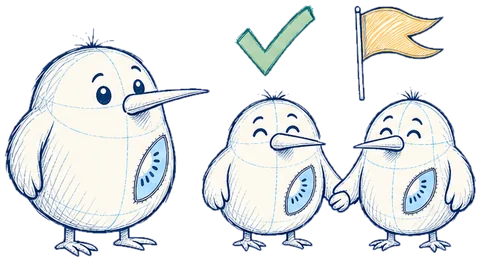
Why it matters
Jealousy as proof of love? Sharing passwords out of trust? Online, control can look like closeness. Knowing the red flags helps you protect yourself and support friends.
In 5 minutes you'll be able to
- Green flags: respecting “no”, privacy and time with other people.
- Red flags: demanding passwords, constant tracking, checking your phone, pressure, jealousy of friends.
- You can set new boundaries at any time and get help.
What you'll practise
Green or red flag?
Sort them: what shows respect, and what is control?
- “Give me your password if you've got nothing to hide.” → Red flag
- Accepts it when you say: “Not today, I'm seeing my mates.” → Green flag
- Wants to see your location 24/7 → Red flag
- Asks before posting a photo of you both → Green flag
- Secretly reads the messages on your phone → Red flag
- Pressures you to send photos you don't want to send → Red flag
- Says honestly when something hurt, without threats → Green flag
- Gets angry when you message certain friends → Red flag
What would you say?
Setting boundaries is hard. Which answer fits?
Noah texts his girlfriend Mia: “If you loved me, you'd share your location with me.” What would be a good reply from Mia?
- “I like you, but my location stays mine. That's not about love.” (Answer)
- “Okay, so you're not annoyed.”
Your friend Hannah says her boyfriend checks her phone every evening. What helps her most?
- Listen and say: “That's not okay. You deserve to be trusted.” (Answer)
- “Your own fault, why do you let him?”
- Call the boyfriend out publicly in a story
What if you've already shared your password?
- You can change it at any time. That's your right. (Answer)
- It's too late now, that would be unfair.
What you can do
If you feel controlled in a relationship or friendship, you're not alone.
- 🔐 Take back access
- Change passwords, turn on two-step login, check location sharing and log out of devices that aren't yours.
- 🗣️ Talk about it
- Tell a friend or an adult you trust what's happening.
- 💬 Get support
- You can talk about relationship worries confidentially. UK: Childline, 0800 1111. US: love is respect, text LOVEIS to 22522.
Remember
Love respects your no, your privacy and your passwords.
Love doesn't need your passwords.
Key facts
- Among US high school students who dated in the past year, 8.5% reported physical dating violence and 9.7% reported sexual dating violence. · Source: CDC, Youth Risk Behavior Survey 2021 (MMWR Supplement, April 2023)
- The CDC says dating violence can take place in person, online or through technology, and includes psychological aggression meant to control a partner as well as sharing sexual images without consent. · Source: CDC, About Teen Dating Violence
- Controlling behaviour often starts small, like checking a phone or asking for a location, and grows step by step. Noticing it early makes it easier to set boundaries.
- Your passwords are only yours. Changing them and turning on two-step login is always your right, in any relationship.
Updated:
Questions people ask
Is it normal for a partner to check your phone?
No. Checking your phone, especially in secret or as a rule, is a sign of control, not trust. In a healthy relationship, both people have privacy.
Should couples share passwords?
You don't have to, and pressure to do so is a red flag. If you've already shared yours, you can change it at any time without explaining.
Is location sharing in a relationship controlling?
It can be. Sharing because you both freely want to is fine, but demanding to see someone's location all the time, or getting angry when they turn it off, is control.
How can I help a friend in a controlling relationship?
Listen without blaming them, tell them they deserve respect, and help them talk to a trusted adult or a confidential helpline. Avoid calling the partner out publicly.
Related terms